
How AI is exposing the gap between the network you built and the intelligence it needs to carry
Every generation or so, a single insight rewires how the world invests in technology. For the last half century, that insight was Moore’s Law. Now there is a second insight known as Huang’s Law. Together they explain why the network infrastructure decisions you made five or ten years ago may be quietly limiting what your venue can do today.
What follows is a story about timing, risk, and money. It’s the story of why the answer to one deceptively simple question, is your infrastructure optimized for AI, may be more consequential than any line item in your construction budget.
First: Moore’s Law, the clock that built your network
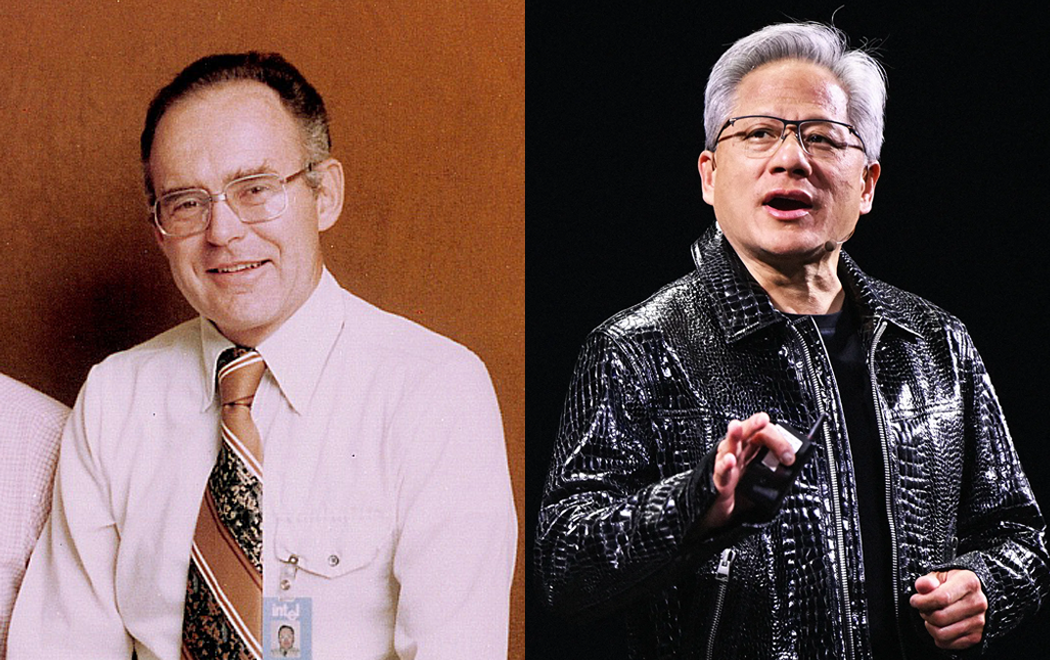
In 1965, Intel co-founder Gordon Moore noticed something remarkable. The number of transistors that could fit on a computer chip was doubling roughly every two years, and the cost per transistor kept dropping. He wrote it down. The industry treated it like a promise.
Think of a transistor as a tiny light switch inside a chip. More switches packed into the same space means more computing power for the same price. Moore’s Law said you could count on that doubling happening, almost like clockwork, for decades. And it did.
The result was a technology economy built on predictability. A programmer in 1995 could design software for hardware that did not yet exist, confident the chips would be cheap and powerful enough by the time the product launched. That is how Steve Jobs could imagine a smartphone years before one was economically possible.
For stadium owners, Moore’s Law created a comfortable logic: buy good infrastructure, depreciate it over seven to ten years, and upgrade on your own schedule. The predictable pace of improvement meant there was rarely a crisis if you waited. The next generation would be better, but not shockingly so. Your Wi-Fi network, your access control system, and your point-of-sale infrastructure: all of it was designed and purchased inside that logic.
That logic is now being tested by something Moore’s Law did not anticipate.
Second: Huang’s Law, the accelerant we did not see coming
Jensen Huang is the CEO of Nvidia, the company whose graphics chips now power most of the world’s artificial intelligence. At a 2018 technology conference in San Jose, he pointed out something the press quickly labeled Huang’s Law: the performance of AI-focused chips was advancing far faster than Moore’s Law predicted.
Moore’s Law expected a roughly 10x improvement in chip performance over five years. However, Huang showed that Nvidia’s chips had delivered 25x improvement over the same period. And unlike Moore’s Law, which was purely about shrinking transistors, Huang’s Law is driven by the entire system: chip architecture, high-speed interconnects, memory design, and AI-optimized software all improving together.
Huang himself put it plainly: “The innovation isn’t just about chips. It’s about the entire stack.”
It is worth being honest that Huang’s Law is not as formally settled as Moore’s Law. Some researchers argue the gains are uneven or cannot last. But the broad direction is not seriously disputed: AI computing performance is improving faster than anything we have seen before, and the improvement is compounding across multiple dimensions at once.
The practical result is a 1,000x improvement in AI computing capability over roughly a decade. Not 10x. One thousand x. The capability that is available to stadium operators today would have been unimaginable when most of the infrastructure currently running in their buildings was designed.
What each law was actually building
Here is where the comparison between Moore’s Law and Huang’s Law becomes directly relevant to how you manage your venue.
Moore’s Law built your stadium’s nervous system. It gave you the ticketing platforms, the Wi-Fi networks, the point-of-sale terminals, the security cameras. Each of those systems was designed to do a specific job, and most of them do it well. They were purchased as capital assets, depreciated over time, and built to last.
Huang’s Law is producing something categorically different. It is not making those existing systems faster. It is enabling a new class of capability that sits on top of them: systems that do not just process information but learn from it, predict from it, and act on it in real time.
Moore’s Law let your stadium know a ticket was scanned. Huang’s Law is what allows a system to predict which concession stand will run out of beer in the next 20 minutes, route a restocking request automatically, and simultaneously deliver a personalized offer to the fan who buys the same brand every game.
The AI tools that make that possible are already available. Most of them are sold as software subscriptions, not capital purchases. The industry moved to that model years ago. The question is not whether to buy or lease the intelligence layer. For most venues, that question is already answered.
The open question is whether the network underneath those tools was built to let them work.
The Comparison in Plain Terms
| Moore’s Law | Huang’s Law | |
| What it drove | Cheaper, faster infrastructure | Smarter, predictive AI systems |
| What it built in stadiums | Networks, ticketing, Wi-Fi, POS | Analytics, prediction, personalization tools |
| How it is typically purchased | Capital expenditure, long depreciation | Software subscription, ongoing OpEx |
| Rate of change | Gradual, predictable | Rapid, compounding |
| The risk of falling behind | Manageable, catching up is possible | Significant, capability gaps widen quickly |
| The infrastructure question | Is the gear still working? | Is the network built to carry this? |
The problem most venue owners have not yet confronted
Most stadiums today run on parallel systems that do not talk to each other. Ticketing data lives in one place. Concession sales in another. Security cameras in a third. Wi-Fi usage somewhere else entirely. Each system was built to do its job, and it does. But because they operate independently, the data they generate stays trapped inside its own silo.
AI cannot learn from data it cannot see.
This is not a software problem. No analytics platform, however sophisticated, can analyze data it cannot access. It is a network architecture problem. The infrastructure that connects your systems determines what your AI tools can and cannot do. A stadium running on separate, parallel networks is a stadium where the intelligence layer is working with one hand tied behind its back.
The solution is what the industry calls a converged network. Instead of running separate systems for separate functions, a converged network routes everything across a single shared IP infrastructure. One network carries ticketing, audio, video, point-of-sale, access control, and building systems together. When data from all of those sources flows across the same infrastructure, it can be collected, compared, and analyzed as a whole.
That is when AI becomes genuinely useful in a venue. Not because the software got smarter, but because the network finally gives it access to the full picture instead of isolated fragments.
It is also worth being precise about what AI actually replaces in a stadium. Most venues already collect enormous amounts of data. The obstacle was never the data. The obstacle was the people required to interpret it quickly enough to act on it. AI removes that bottleneck. It does not make your access points obsolete. It makes the human analysis layer obsolete. Your existing hardware may have more useful life than a simple obsolescence argument implies. What changes is whether it is connected in a way that lets AI do anything with what it collects.
The investment question worth asking
The technology industry has already made its decision about the intelligence. AI tools are subscriptions. That model is established. The acceleration Huang’s Law describes is exactly why: when capability is improving this fast, nobody wants to own last year’s version.
The less examined question is the one underneath it. The network infrastructure in your building was almost certainly designed in a Moore’s Law world, built to carry specific systems, depreciated on a long schedule, and expected to last. It may still be functioning exactly as designed. The issue is that “functioning as designed” no longer means “capable of carrying what the market now offers.”
A stadium owner who subscribes to AI-powered analytics tools but runs them on a fragmented, siloed network is paying for capability the infrastructure cannot deliver. The bottleneck is not the software. It is in the foundation.
That is the question Huang’s Law is forcing into the open: not whether to invest in intelligence, but whether the network you built to carry Moore’s Law technology is ready to carry Huang’s.
Answering this honestly, before the next renovation or the next technology contract, may be the most consequential infrastructure decision a venue owner makes in this decade.