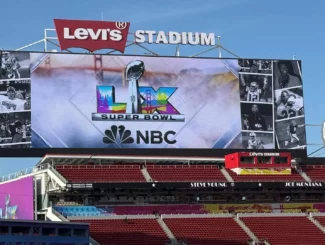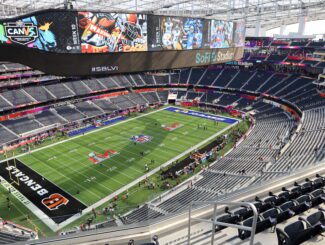

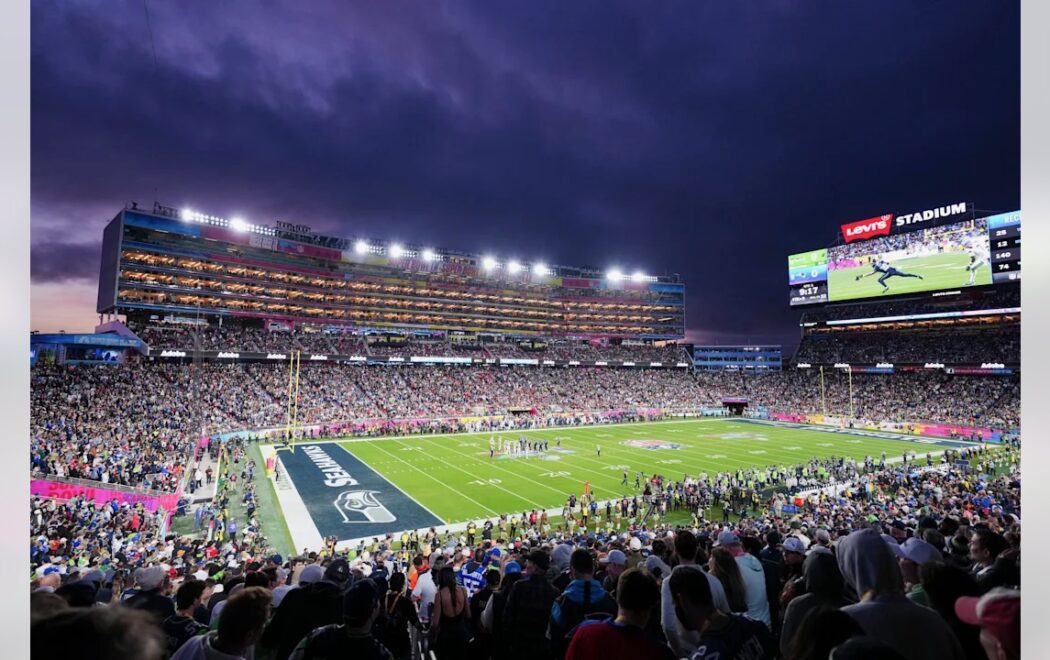
The newly upgraded distributed antenna system (DAS) at Levi’s Stadium proved itself up to the annual Super Bowl stress test Sunday, with Verizon, AT&T and T-Mobile all claiming new stadium records or big increases for game-day wireless data use on their networks during Super Bowl 60.
According to Verizon, its customers used 40.32 terabytes of data “in and around the stadium” on game day, well eclipsing the mark of 7 TB of data used by Verizon customers a decade ago at Super Bowl 50. AT&T, meanwhile, reported 24.4 TB of data used by its customers at Levi’s Stadium Sunday, for a two-carrier total of 64.72 TB. T-Mobile reported approximately 11 TB of usage by its customers, which the company said represented big jumps in usage compared to the past two years.
The Levi’s Stadium DAS, first built way back when by DAS Group Professionals (now a part of AFL Wireless Services), carried 15.9 TB of total data during Super Bowl 50 in 2016. During that game AT&T customers used 5.2 TB of data, followed by T-Mobile with 2.1 TB, and Sprint with 1.6 TB.
Even though Super Bowl 60 had a higher reported attendance (70,823 fans) than Super Bowl 59 (65,819), the combined cellular totals for Verizon and AT&T were a bit lower for this year’s game when compared to last year’s Super Bowl 59, where AT&T and Verizon combined to see 67 TB of wireless data used. T-Mobile did not report usage statistics for Super Bowl 59.
According to Verizon, it had approximately 42,210 of its customers on the Levi’s Stadium networks Sunday, which works out to about 955 megabytes of data used per connected Verizon customer, just below the 1.09 GB per customer data mark we saw from Verizon last year. AT&T did not provide a number of connected customers, so we can’t calculate their per-user data.
T-Mobile noted that its traffic numbers include usage only during the actual game time. Verizon and AT&T numbers include traffic calculated during a 24-hour window surrounding the event.